 Add to Chrome
 Add to Firefox
 Add to Edge
Beyond Waveform Robustness: Robust Feature-Vocoder Adversarial Attacks on Automatic Speech Recognition
Jun 04, 2026
Automatic speech recognition (ASR) systems have become widely used for multilingual speech-to-text transcription. Their robustness to adversarial attacks has become an important topic for the community. Existing adversarial attacks directly add adversarial noise to the speech audio. However, prior work has shown that existing adversarial attacks face two limitations: they often transfer poorly to black-box ASR systems and are increasingly mitigated by defenses tailored to input-space perturbations. In this work, we propose a Clean-Referenced Feature-Vocoder Attack, a surrogate-based black-box attack that moves the adversarial search space from raw waveforms to self-supervised learning (SSL) representations. To address the transferability limitation, we perturb more generalizable acoustic-phonetic representations rather than low-level waveform samples, reducing dependence on surrogate-specific waveform gradients and encouraging adversarial perturbations that generalize across ASR systems. To bypass different defenses, we shift the adversarial signal from explicit additive waveform noise to SSL feature-space perturbations and reconstruct them through a vocoder into speech-like waveform adversarial signals, making the resulting samples less aligned with waveform-bounded defenses. Extensive experiments show that, when optimized only on raw Whisper-small as a public surrogate model, our attack transfers effectively to black-box ASR models with a +26.6 WER improvement over the SOTA baseline, while also remaining effective against multiple training defenses with a +36.2 WER improvement. These results reveal a blind spot in current ASR robustness evaluation.

Autonomous heterogeneous catalyst discovery with a self-evolving multi-agent digital twin
Jun 03, 2026Theoretical heterogeneous catalysis promises rapid catalyst discovery, yet computational and machine-learning predictions often deviate from experiment and stay confined to narrow material families, for want of a faithful, condition-aware catalytic simulator. We present CatDT (Catalysis Digital Twin), a self-evolving multi-agent system that builds an autonomous digital twin of a working catalyst, unifying gas-solid and liquid-solid modeling. From only a bulk crystal and a natural-language reaction description, eight specialized agents and 27 scientific tools predict stable facets, reconstruct working surfaces, enumerate and rank reaction pathways, locate transition states, and compute kinetics in 5-30 min on a single GPU. Two innovations address the hardest steps: UniMech finds dominant pathways for novel materials at over $10^3\times$ lower cost than exhaustive enumeration by fusing agent-guided proposals with energy-cached graph search, and a memory-augmented reinforcement loop raises barrier-calculation success from 41\% to 84\% across 600 catalytic surfaces. Across seven gas-solid benchmarks -- stepped metals, single-atom catalysts, ordered intermetallics, vacancy-rich 2D sulfides and carbides, and a strong-metal--support-interaction (SMSI) interface -- every CatDT prediction lies within 0.5-2 times experiment over four orders of magnitude. For propane dehydrogenation, CatDT independently discovers non-precious candidates rivaling the Pt-based industrial benchmark, with a proposed Ni@ZrO$_2$ SMSI overlayer reaching a simulated TOF of $1.63~\text{s}^{-1}$ at $\sim$100\% selectivity. More broadly, the decisive factor for a faithful catalyst digital twin -- or any multi-stage scientific simulator -- is not raw LLM capability but the engineered harness around it: deterministic tools, persistent memory, and verified self-improvement that compound across models, tools, and runs.
Stego Battlefield: Evaluating Image Steganography Attacks and Steganalysis Defenses
May 07, 2026Image steganography is widely used to protect user privacy and enable covert communication. However, it can also be abused by the adversary as a covert channel to bypass content moderation, disseminate harmful semantics, and even hide malicious instructions in images to elicit dangerous outputs from large models, posing a practical security risk that continues to evolve. To address the lack of a unified and systematic evaluation framework, we propose SADBench, a systematic benchmark that assesses the adversary's ability to inject harmful secrets via steganography and the defender's ability to detect such threats through steganalysis. Crucially, SADBench comprises $4$ core tasks, namely steganography attack capability evaluation, steganalysis defense capability evaluation, efficiency evaluation, and transferability evaluation. It evaluates both image-payload and text-payload steganography across diverse cover distributions, utilizing harmful visual semantics and toxic instructions to simulate malicious attacks. Across a broad set of attacks and detectors, SADBench reveals that (i) INN and autoencoder-based methods demonstrate superior stability compared to other architectures, (ii) in-domain detection is near-perfect and cheaper than generation, (iii) a critical asymmetry exists in transferability where attacks robustly generalize to new distributions while detectors fail to adapt, and (iv) real-world threats persist on social media, where payloads either survive minimal compression or effectively adapt to aggressive compression via simulated training. Overall, SADBench establishes a systematic, reproducible, and extensible framework to quantify risks, paving the way for measurable and security-driven advancements in steganography defense.
From Knowledge to Action: Outcomes of the 2025 Large Language Model (LLM) Hackathon for Applications in Materials Science and Chemistry
May 04, 2026Large language models (LLMs) are rapidly changing how researchers in materials science and chemistry discover, organize, and act on scientific knowledge. This paper analyzes a broad set of community-developed LLM applications in an effort to identify emerging patterns in how these systems can be used across the scientific research lifecycle. We organize the projects into two complementary categories: Knowledge Infrastructure, systems that structure, retrieve, synthesize, and validate scientific information; and Action Systems, systems that execute, coordinate, or automate scientific work across computational and experimental environments. The submissions reveal a shift from single-purpose LLM tools toward integrated, multi-agent workflows that combine retrieval, reasoning, tool use, and domain-specific validation. Prominent themes include retrieval-augmented generation as grounding infrastructure, persistent structured knowledge representations, multimodal and multilingual scientific inputs, and early progress toward laboratory-integrated closed-loop systems. Together, these results suggest that LLMs are evolving from general-purpose assistants into composable infrastructure for scientific reasoning and action. This work provides a community snapshot of that transition and a practical taxonomy for understanding emerging LLM-enabled workflows in materials science and chemistry.
CHASM: Unveiling Covert Advertisements on Chinese Social Media
Apr 22, 2026Current benchmarks for evaluating large language models (LLMs) in social media moderation completely overlook a serious threat: covert advertisements, which disguise themselves as regular posts to deceive and mislead consumers into making purchases, leading to significant ethical and legal concerns. In this paper, we present the CHASM, a first-of-its-kind dataset designed to evaluate the capability of Multimodal Large Language Models (MLLMs) in detecting covert advertisements on social media. CHASM is a high-quality, anonymized, manually curated dataset consisting of 4,992 instances, based on real-world scenarios from the Chinese social media platform Rednote. The dataset was collected and annotated under strict privacy protection and quality control protocols. It includes many product experience sharing posts that closely resemble covert advertisements, making the dataset particularly challenging.The results show that under both zero-shot and in-context learning settings, none of the current MLLMs are sufficiently reliable for detecting covert advertisements.Our further experiments revealed that fine-tuning open-source MLLMs on our dataset yielded noticeable performance gains. However, significant challenges persist, such as detecting subtle cues in comments and differences in visual and textual structures.We provide in-depth error analysis and outline future research directions. We hope our study can serve as a call for the research community and platform moderators to develop more precise defenses against this emerging threat.
IP-Bench: Benchmark for Image Protection Methods in Image-to-Video Generation Scenarios
Mar 27, 2026With the rapid advancement of image-to-video (I2V) generation models, their potential for misuse in creating malicious content has become a significant concern. For instance, a single image can be exploited to generate a fake video, which can be used to attract attention and gain benefits. This phenomenon is referred to as an I2V generation misuse. Existing image protection methods suffer from the absence of a unified benchmark, leading to an incomplete evaluation framework. Furthermore, these methods have not been systematically assessed in I2V generation scenarios and against preprocessing attacks, which complicates the evaluation of their effectiveness in real-world deployment scenarios.To address this challenge, we propose IP-Bench (Image Protection Bench), the first systematic benchmark designed to evaluate protection methods in I2V generation scenarios. This benchmark examines 6 representative protection methods and 5 state-of-the-art I2V models. Furthermore, our work systematically evaluates protection methods' robustness with two robustness attack strategies under practical scenarios and analyzes their cross-model & cross-modality transferability. Overall, IP-Bench establishes a systematic, reproducible, and extensible evaluation framework for image protection methods in I2V generation scenarios.
Backdoor Attacks on Prompt-Driven Video Segmentation Foundation Models
Dec 26, 2025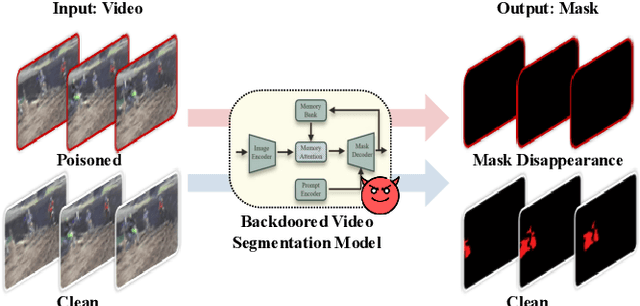
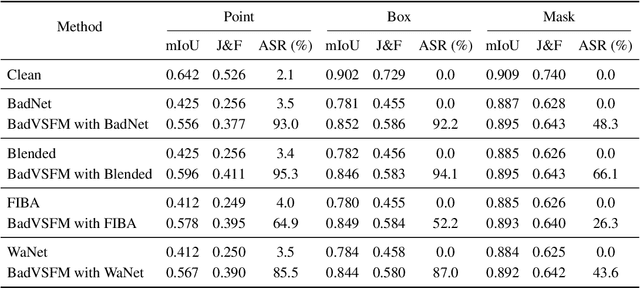
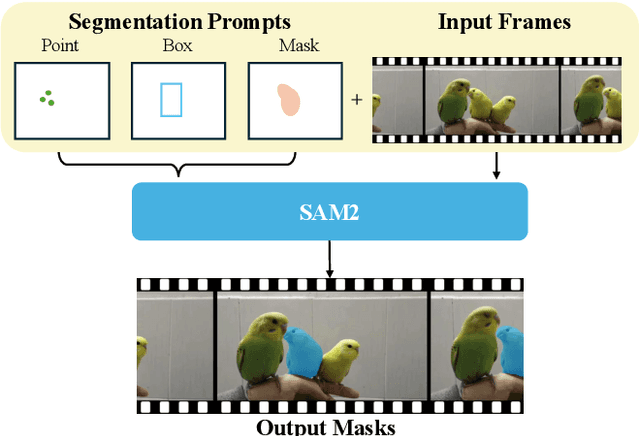
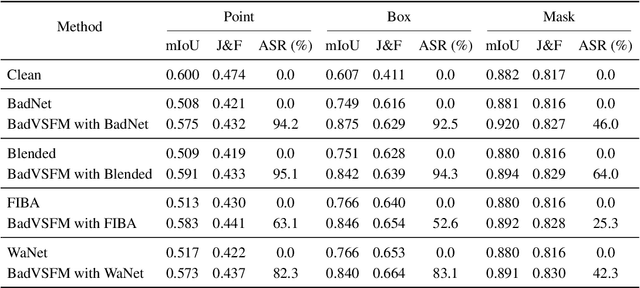
Prompt-driven Video Segmentation Foundation Models (VSFMs) such as SAM2 are increasingly deployed in applications like autonomous driving and digital pathology, raising concerns about backdoor threats. Surprisingly, we find that directly transferring classic backdoor attacks (e.g., BadNet) to VSFMs is almost ineffective, with ASR below 5\%. To understand this, we study encoder gradients and attention maps and observe that conventional training keeps gradients for clean and triggered samples largely aligned, while attention still focuses on the true object, preventing the encoder from learning a distinct trigger-related representation. To address this challenge, we propose BadVSFM, the first backdoor framework tailored to prompt-driven VSFMs. BadVSFM uses a two-stage strategy: (1) steer the image encoder so triggered frames map to a designated target embedding while clean frames remain aligned with a clean reference encoder; (2) train the mask decoder so that, across prompt types, triggered frame-prompt pairs produce a shared target mask, while clean outputs stay close to a reference decoder. Extensive experiments on two datasets and five VSFMs show that BadVSFM achieves strong, controllable backdoor effects under diverse triggers and prompts while preserving clean segmentation quality. Ablations over losses, stages, targets, trigger settings, and poisoning rates demonstrate robustness to reasonable hyperparameter changes and confirm the necessity of the two-stage design. Finally, gradient-conflict analysis and attention visualizations show that BadVSFM separates triggered and clean representations and shifts attention to trigger regions, while four representative defenses remain largely ineffective, revealing an underexplored vulnerability in current VSFMs.
6DAttack: Backdoor Attacks in the 6DoF Pose Estimation
Dec 22, 2025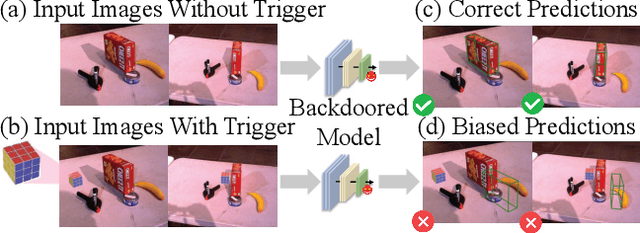
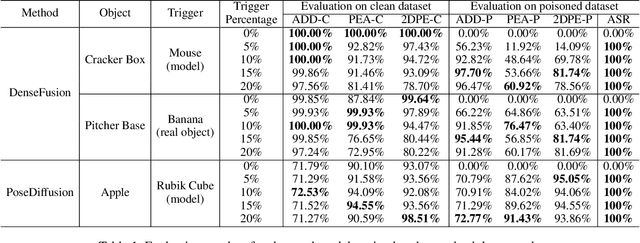
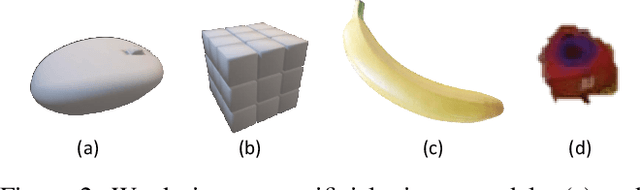
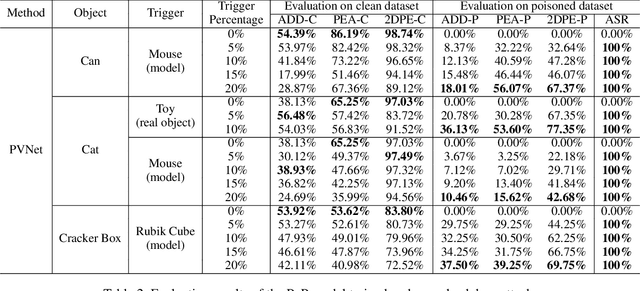
Deep learning advances have enabled accurate six-degree-of-freedom (6DoF) object pose estimation, widely used in robotics, AR/VR, and autonomous systems. However, backdoor attacks pose significant security risks. While most research focuses on 2D vision, 6DoF pose estimation remains largely unexplored. Unlike traditional backdoors that only change classes, 6DoF attacks must control continuous parameters like translation and rotation, rendering 2D methods inapplicable. We propose 6DAttack, a framework using 3D object triggers to induce controlled erroneous poses while maintaining normal behavior. Evaluations on PVNet, DenseFusion, and PoseDiffusion across LINEMOD, YCB-Video, and CO3D show high attack success rates (ASRs) without compromising clean performance. Backdoored models achieve up to 100% clean ADD accuracy and 100% ASR, with triggered samples reaching 97.70% ADD-P. Furthermore, a representative defense remains ineffective. Our findings reveal a serious, underexplored threat to 6DoF pose estimation.
SynDec: A Synthesize-then-Decode Approach for Arbitrary Textual Style Transfer via Large Language Models
May 19, 2025Large Language Models (LLMs) are emerging as dominant forces for textual style transfer. However, for arbitrary style transfer, LLMs face two key challenges: (1) considerable reliance on manually-constructed prompts and (2) rigid stylistic biases inherent in LLMs. In this paper, we propose a novel Synthesize-then-Decode (SynDec) approach, which automatically synthesizes high-quality prompts and amplifies their roles during decoding process. Specifically, our approach synthesizes prompts by selecting representative few-shot samples, conducting a four-dimensional style analysis, and reranking the candidates. At LLM decoding stage, the TST effect is amplified by maximizing the contrast in output probabilities between scenarios with and without the synthesized prompt, as well as between prompts and negative samples. We conduct extensive experiments and the results show that SynDec outperforms existing state-of-the-art LLM-based methods on five out of six benchmarks (e.g., achieving up to a 9\% increase in accuracy for modern-to-Elizabethan English transfer). Detailed ablation studies further validate the effectiveness of SynDec.
"I Can See Forever!": Evaluating Real-time VideoLLMs for Assisting Individuals with Visual Impairments
May 07, 2025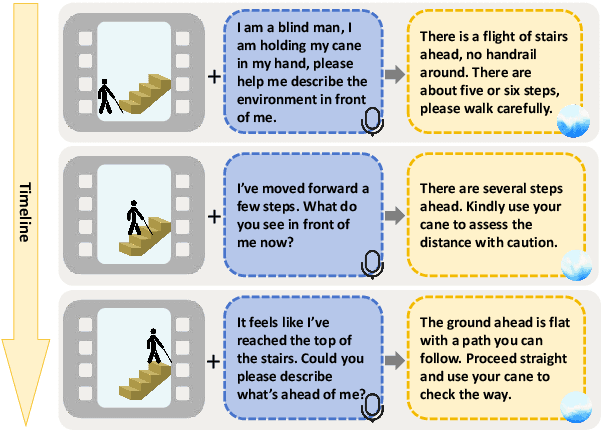
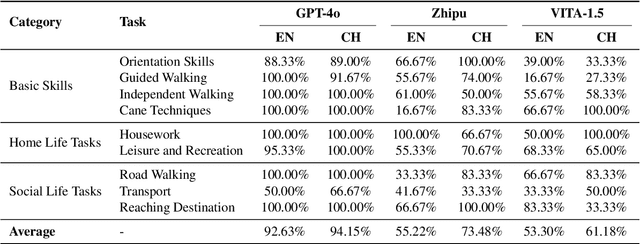
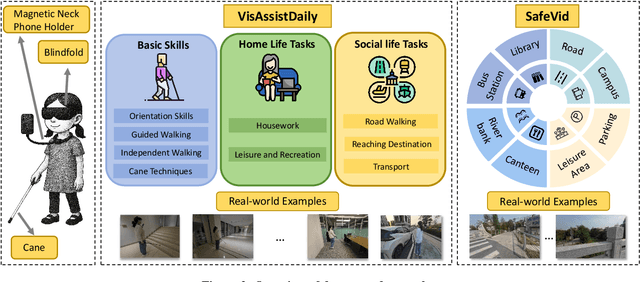
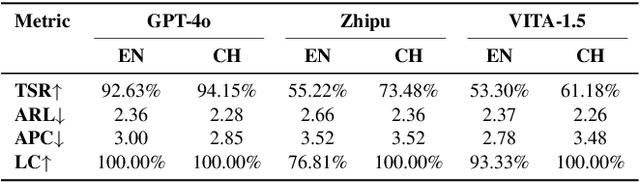
The visually impaired population, especially the severely visually impaired, is currently large in scale, and daily activities pose significant challenges for them. Although many studies use large language and vision-language models to assist the blind, most focus on static content and fail to meet real-time perception needs in dynamic and complex environments, such as daily activities. To provide them with more effective intelligent assistance, it is imperative to incorporate advanced visual understanding technologies. Although real-time vision and speech interaction VideoLLMs demonstrate strong real-time visual understanding, no prior work has systematically evaluated their effectiveness in assisting visually impaired individuals. In this work, we conduct the first such evaluation. First, we construct a benchmark dataset (VisAssistDaily), covering three categories of assistive tasks for visually impaired individuals: Basic Skills, Home Life Tasks, and Social Life Tasks. The results show that GPT-4o achieves the highest task success rate. Next, we conduct a user study to evaluate the models in both closed-world and open-world scenarios, further exploring the practical challenges of applying VideoLLMs in assistive contexts. One key issue we identify is the difficulty current models face in perceiving potential hazards in dynamic environments. To address this, we build an environment-awareness dataset named SafeVid and introduce a polling mechanism that enables the model to proactively detect environmental risks. We hope this work provides valuable insights and inspiration for future research in this field.